
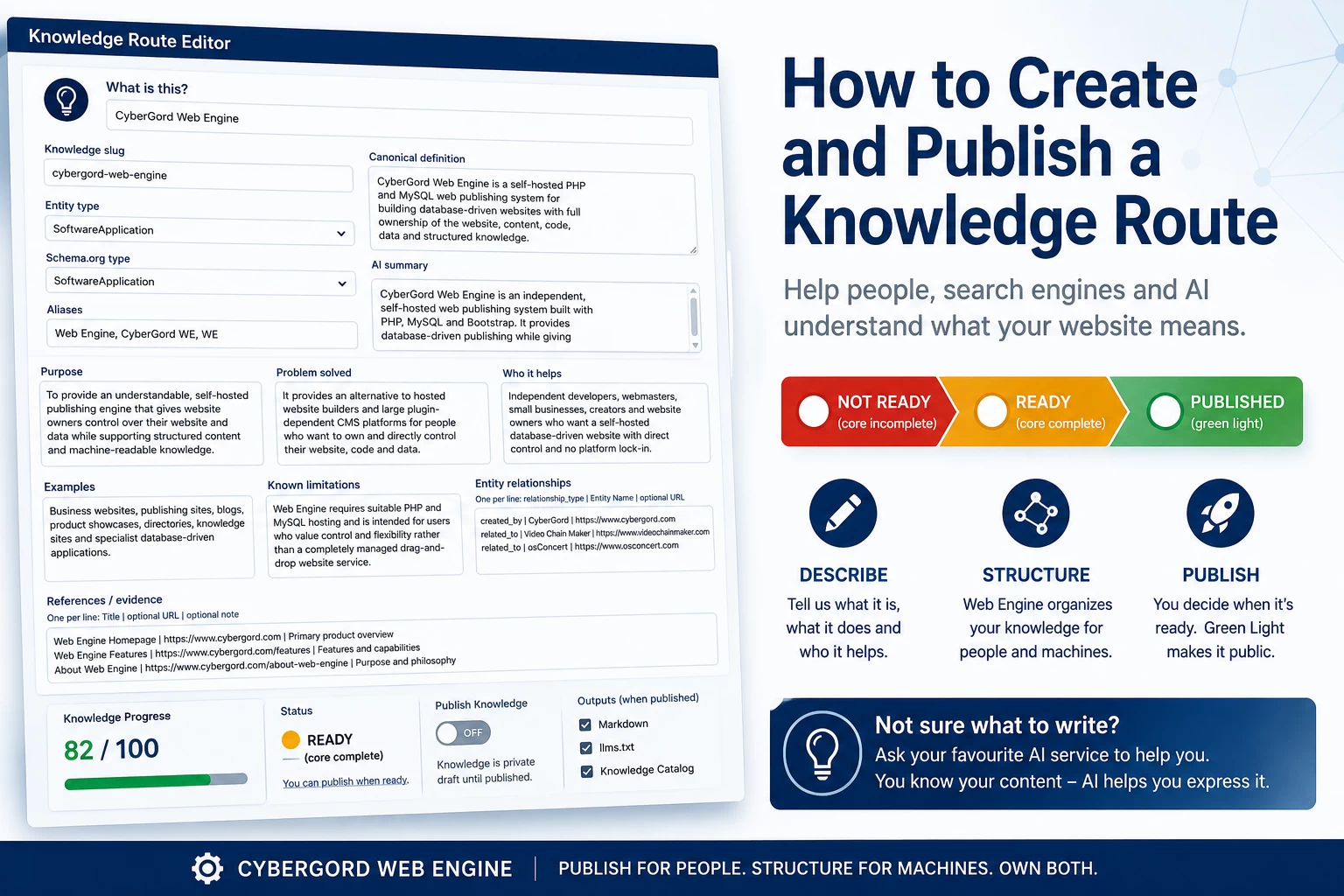
How to Create and Publish a Knowledge Route
A practical guide to helping people, search engines and AI understand what your website means
A practical guide to helping people, search engines and AI understand what your website means
A normal website publishes pages for people.
Those pages may contain excellent information, but a search engine or AI system still has to read the content, interpret it and work out what the page is really about.
CyberGord Web Engine Knowledge Routes give you another option.
A Knowledge Route lets you explicitly describe the meaning behind an important page, product, service, organisation or concept.
Instead of leaving a machine to guess:
What is this? Who is it for? Why does it exist? How is it related to other things?
you can provide those answers directly.
The process does not require specialist knowledge of artificial intelligence, structured data or search technology.
You simply describe what you know. Web Engine structures it.
And if you are unsure how to phrase something, you can ask your favourite AI service — ChatGPT, Claude, Gemini, Copilot or another assistant — to help you prepare the text.
Start with the most important question: What is this?
Every Knowledge Route describes an entity.
An entity is simply the thing you want machines to understand.
It could be:
- a product
- a business
- a service
- an organisation
- a person
- a software application
- a project
- a concept
- an important website page
For example, the homepage of the CyberGord website primarily represents CyberGord Web Engine.
So its Knowledge Route begins:
What is this?
CyberGord Web Engine
From there, Web Engine helps build a structured description of that entity.
Completing the Knowledge Form
You do not have to complete everything at once.
Web Engine measures your Knowledge Progress while you work and uses a simple traffic-light system to show when the essential information is ready.
What is this?
Enter the clear, recognised name of the thing being described.
Examples:
CyberGord Web Engine
ABC Theatre Company
Online Ticket Booking
Annual Shakespeare Festival
Avoid clever marketing slogans here. This is the entity's identity.
Knowledge slug
This is a short machine-friendly name.
For example:
cybergord-web-engine
or:
annual-shakespeare-festival
Keep it short, descriptive and lowercase, normally using hyphens between words.
Entity type
Describe the general kind of thing this is.
Examples:
SoftwareApplication
Organisation
Service
Product
Person
Event
Concept
It does not need to be complicated. The purpose is simply to tell machines what class of entity they are dealing with.
Schema.org type
This identifies the closest appropriate Schema.org classification.
Examples might include:
SoftwareApplication
Organization
Product
Service
Event
Person
WebPage
If you are unsure, this is a perfect question to ask an AI assistant:
“I am creating structured Knowledge for a theatre organisation. What Schema.org type would best describe it?”
You can then decide whether its suggestion makes sense.
Aliases
Add other public names by which the entity may be known.
For example:
Web Engine, CyberGord WE, WE
Aliases help machines understand that different names may refer to the same thing.
Do not invent synonyms merely to fill the field.
Canonical definition
This is one of the most important fields.
Answer:
What is this?
in one clear, authoritative statement.
For example:
CyberGord Web Engine is a self-hosted PHP and MySQL web publishing system for building database-driven websites with full ownership of the website, content, code, data and structured knowledge.
Imagine somebody asked you at a meeting:
“What exactly is your product?”
The canonical definition should be the concise answer.
Avoid exaggerated advertising language. Clarity is more valuable than hype.
AI summary
Now provide a slightly broader standalone explanation.
The AI summary should make sense even if it is read without the rest of the website.
It can explain:
- what the entity is
- what it does
- its important characteristics
- how it differs
- its broader context
Usually a short paragraph is enough.
You are not writing an essay. You are giving machines a reliable summary they can understand without reconstructing one from several webpages.
Purpose
Answer:
Why does this exist?
For example:
To provide an understandable, self-hosted publishing engine that gives website owners control over their website and data while supporting structured content and machine-readable knowledge.
A purpose is different from a feature list.
It describes the reason for the entity's existence.
Problem solved
Answer:
What problem does this help solve?
For example:
It provides an alternative to hosted website builders and plugin-dependent CMS platforms for people who want to own and directly control their website, code, content and database.
Not every entity needs an elaborate problem statement.
If it genuinely does not solve a particular problem, don't manufacture one simply to increase the score.
Who it helps
Describe the people or organisations most likely to benefit.
For example:
Independent developers, webmasters, small businesses, creators and website owners who want a self-hosted database-driven website with direct control and no platform lock-in.
This gives machines important context.
A system may understand what a product does but still fail to understand who it is relevant to.
Examples
Examples make abstract descriptions concrete.
You might provide examples of:
- how a product can be used
- types of customers
- situations where the service applies
- real applications of a concept
For example:
Business websites, publishing sites, blogs, product showcases, directories, knowledge sites and specialist database-driven applications.
Only include genuine examples.
Known limitations
This field is deliberately included because useful Knowledge should not merely advertise.
Explain meaningful limitations or boundaries.
For example:
Web Engine requires suitable PHP and MySQL hosting and is intended for users who value control and flexibility rather than a completely managed drag-and-drop website service.
Clear limitations help establish context and prevent machines from making overly broad assumptions.
They also make the Knowledge more trustworthy.
Entity relationships
This is where Knowledge becomes particularly powerful.
A website does not consist of isolated facts. Products, people, organisations and ideas are related to one another.
Web Engine allows you to describe those relationships using:
relationship_type | Entity Name | optional URL
For example:
created_by | CyberGord | https://www.cybergord.com
related_to | Video Chain Maker | https://www.videochainmaker.com
related_to | osConcert | https://www.osconcert.com
You are effectively saying:
“If you understand this entity, these are some other things you should understand in relation to it.”
Over time, these connections can create a meaningful Knowledge network across your website and related projects.
References and evidence
References tell readers and machines where the information can be supported or explored further.
The format is:
Reference title | optional URL | optional note
For example:
Web Engine Homepage | https://www.cybergord.com | Primary product overview
Web Engine Features | https://www.cybergord.com/features | Detailed capabilities
References are particularly useful for important claims, specifications and factual information.
They also help distinguish authoritative Knowledge from unsupported assertion.
You do not have to reach 100/100
This is important.
The Knowledge Progress score is a guide, not a competition.
Web Engine uses three states.