
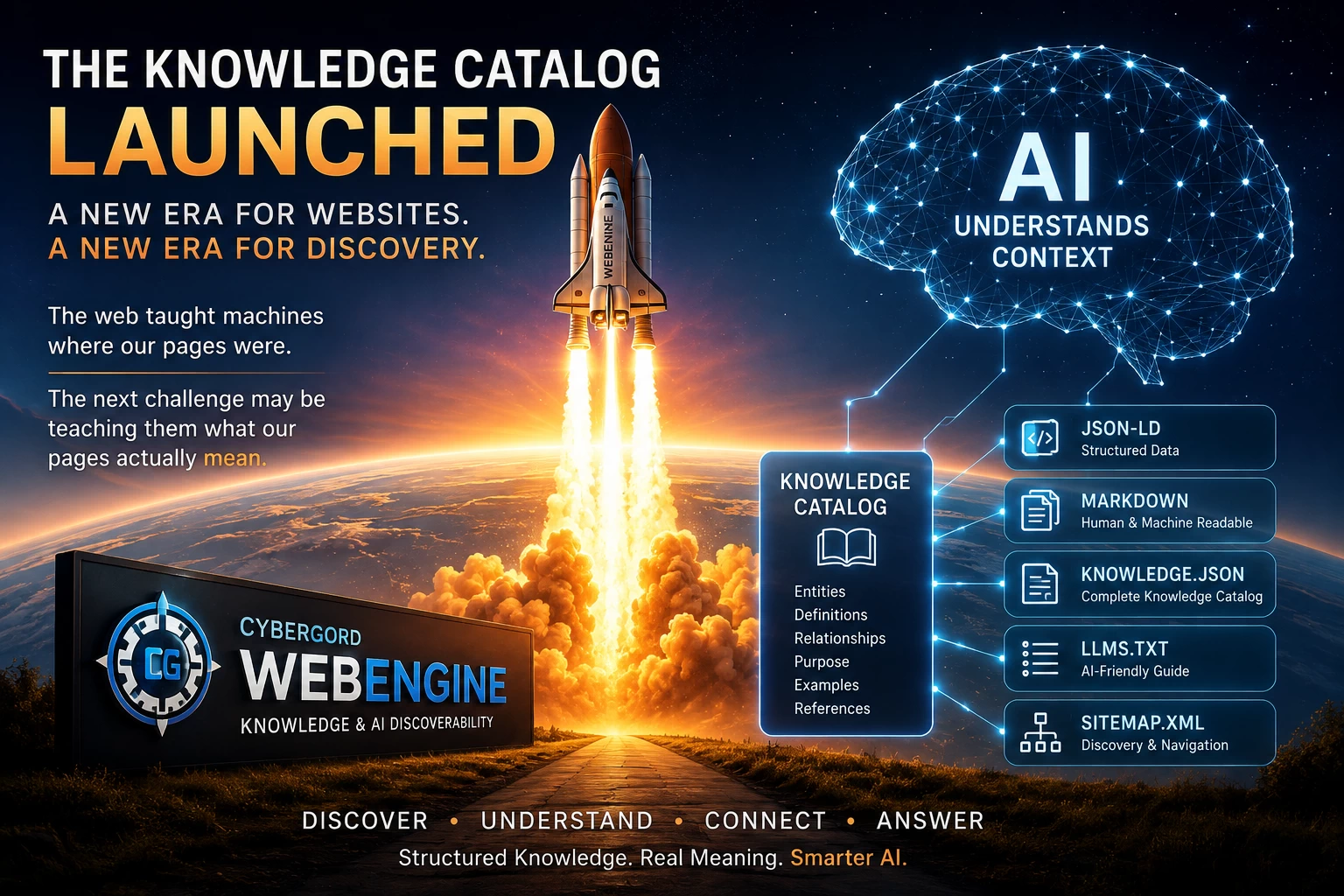
The Knowledge Catalog Experiment Begins
The Knowledge Catalog Experiment Begins
August 12, 2026
For more than twenty years, websites have largely been designed around one primary audience: people.
We build navigation for people. We create layouts for people. We optimize pages for search engines so that people can find them.
But another audience is rapidly becoming important.
AI systems.
People are increasingly asking ChatGPT, Copilot, Gemini, Claude, DeepSeek and other AI systems questions that they once typed into traditional search engines.
They don't always ask:
“Find me a website about this.”
Instead they ask:
“What is the easiest way to do this?”
“What tools can help me solve this problem?”
“Explain this subject to me.”
“What would you recommend?”
That changes the challenge for a webmaster.
It is no longer enough for a website simply to exist.
An AI system needs to be able to discover it, understand what it represents, understand the concepts around it and connect those concepts with the questions people are asking.
That led me to a question:
Can We Build Websites That Explain Themselves Better to AI?
During August 2026 I began extending the CyberGord WebEngine with something I am calling its Knowledge Catalog.
The idea is straightforward.
A conventional website presents pages to people.
The Knowledge Catalog provides an additional structured description of the important entities, concepts, products, articles and relationships contained within that website.
Instead of relying entirely on an AI crawler to work out what a page means, WebEngine can explicitly describe it.
For important content we can now define information such as:
- a canonical definition
- an AI-readable summary
- purpose
- the problem being solved
- who the information helps
- examples and limitations
- related entities and concepts
- supporting references
WebEngine can then publish that information through ordinary semantic HTML and structured resources including JSON-LD, Markdown representations, knowledge.json, llms.txt and XML sitemap information.
I call the overall approach Knowledge Architecture.
And on August 12, 2026, I started an experiment to see whether it actually makes a difference.
The Video Chain Maker Test
I needed a real project to test.
Video Chain Maker was an obvious candidate.
Video Chains are a new concept, and that creates an interesting problem for AI.
If an AI system has never properly encountered the concept, how does it know what a Video Chain is?
So before completing the new Knowledge Architecture, I asked several major AI systems some controlled questions.
The results were fascinating.
Microsoft Copilot
Copilot already knew a surprising amount about Video Chain Maker and Video Clip Directory and even understood the relationship between them.
But ask:
“What is a Video Chain?”
and things became much less certain.
The response wandered into blockchain-related concepts, cryptographic chains, filmmaking and other interpretations.
In other words:
It knew the product, but it didn't clearly know the concept.
Claude
Claude could discover Video Chain Maker, but it took increasingly specific questions before the application appeared as a recommendation.
That suggested another problem.
The product might be known, but the relationship between a user's problem and the tool that could help solve it was weak.
Gemini
Gemini could provide a brief response when explicitly asked about videochainmaker.com.
But broader questions describing exactly the type of problem Video Chain Maker was designed to solve did not result in it being recommended.
Again:
Website recognition does not necessarily equal problem recognition.
DeepSeek
DeepSeek provided perhaps the clearest baseline.
When asked about VideoChainMaker.com, it said that there appeared to be no widely recognized product by that name and speculated that it might be an AI video generator, professional editing application, video concatenation utility or another specialist tool.
Those guesses were understandable.
But they were wrong.
And that is precisely why this experiment interests me.
Instead of Complaining, Let's Give AI Better Information
An AI system cannot be expected to understand something new simply because I built it.
So rather than trying to trick search engines, stuff pages with keywords or complain that AI systems don't know about my work, I'm taking the opposite approach.
Give them better information.
The Video Chain Maker website has now been given structured Knowledge records describing its important concepts and content.
Its articles have been connected to ideas including:
Video Chains → curation → storytelling → education → documentaries → personal greetings → research → structured data → personal video collections → clip discovery.
The relationship between the applications is also explicitly described:
Video Clip Directory
        ↓
collect useful video moments
        ↓
Video Chain Maker
        ↓
select + order + refine
        ↓
Video Chain
        ↓
share, reuse or publish
And WebEngine publishes machine-readable representations alongside the normal website.
The intention isn't to tell an AI:
“Recommend my product.”
It is to provide enough clear, consistent and structured information for an AI system to understand:
What is this?
What does it do?
What problem does it solve?
How is it related to these other concepts?
When might this information be relevant?
That's a much more interesting challenge.
Now We Wait
This is where the experiment really begins.
I have preserved the original questions and responses from August 12, 2026.
Over the coming months I will ask the same questions again.
I want to see whether anything changes.
Will an AI system eventually understand Video Chain as the concept I am describing?
Will it understand the relationship between Video Chain Maker and Video Clip Directory?
More importantly, when somebody describes the problem without mentioning my product at all, will an AI system eventually recognize Video Chain Maker as a relevant tool?
Maybe.
Maybe not.
That's why it's an experiment.
Is This the Beginning of a New Kind of SEO?
For years, webmasters have practiced Search Engine Optimization.
SEO helped search engines understand pages so that those pages could be presented to people searching for relevant information.
AI discovery introduces another challenge.
Perhaps we now need to think about whether our websites contain enough structured knowledge for machines to understand not merely the words on a page, but the meaning and relationships behind them.
I'm not interested in inventing another collection of tricks for manipulating rankings.
I'm much more interested in something fundamental:
Can a website clearly explain what it knows?
That's the direction I'm taking with CyberGord WebEngine.
Knowledge & AI Discoverability Is Now Part of WebEngine
From August 2026, Knowledge & AI Discoverability is part of the standard CyberGord WebEngine architecture.
A WebEngine website can still be a perfectly ordinary website.
It can contain pages, articles, videos, images, navigation and everything visitors expect.
But important content can now have another dimension:
structured meaning.
The WebEngine can publish both:
A website designed for people
and
A Knowledge Catalog designed to help machines understand the website
I don't yet know how important that distinction will become.
That's another reason I'm building it now rather than waiting until everybody agrees on the answer.
August 12, 2026 — The Starting Line
So this article is also a timestamp.
On August 12, 2026, the CyberGord WebEngine Knowledge Catalog experiment began.
Video Chain Maker is the first real test.
The original AI responses have been recorded.
The Knowledge Architecture has been published.
Now we'll give the systems time to discover it.
Then we'll ask exactly the same questions again.
If the answers improve, we'll have something worth investigating.
If they don't, we'll learn from that too.
Either way, I'll document what happens.
The web taught machines where our pages were.
The next challenge may be teaching them what our pages actually mean.